Your operations manager in Mississauga has been with you 7 years and 4 months and earns $1,500 a week. You've decided to end the job without cause. Under Ontario's Employment Standards Act, 2000, you owe 7 weeks of written notice or pay in lieu, and if your payroll is $2.5 million or more you also owe severance pay in Ontario of about 7.4 weeks. That comes to roughly $22,000 plus benefits, and it is the legal minimum.
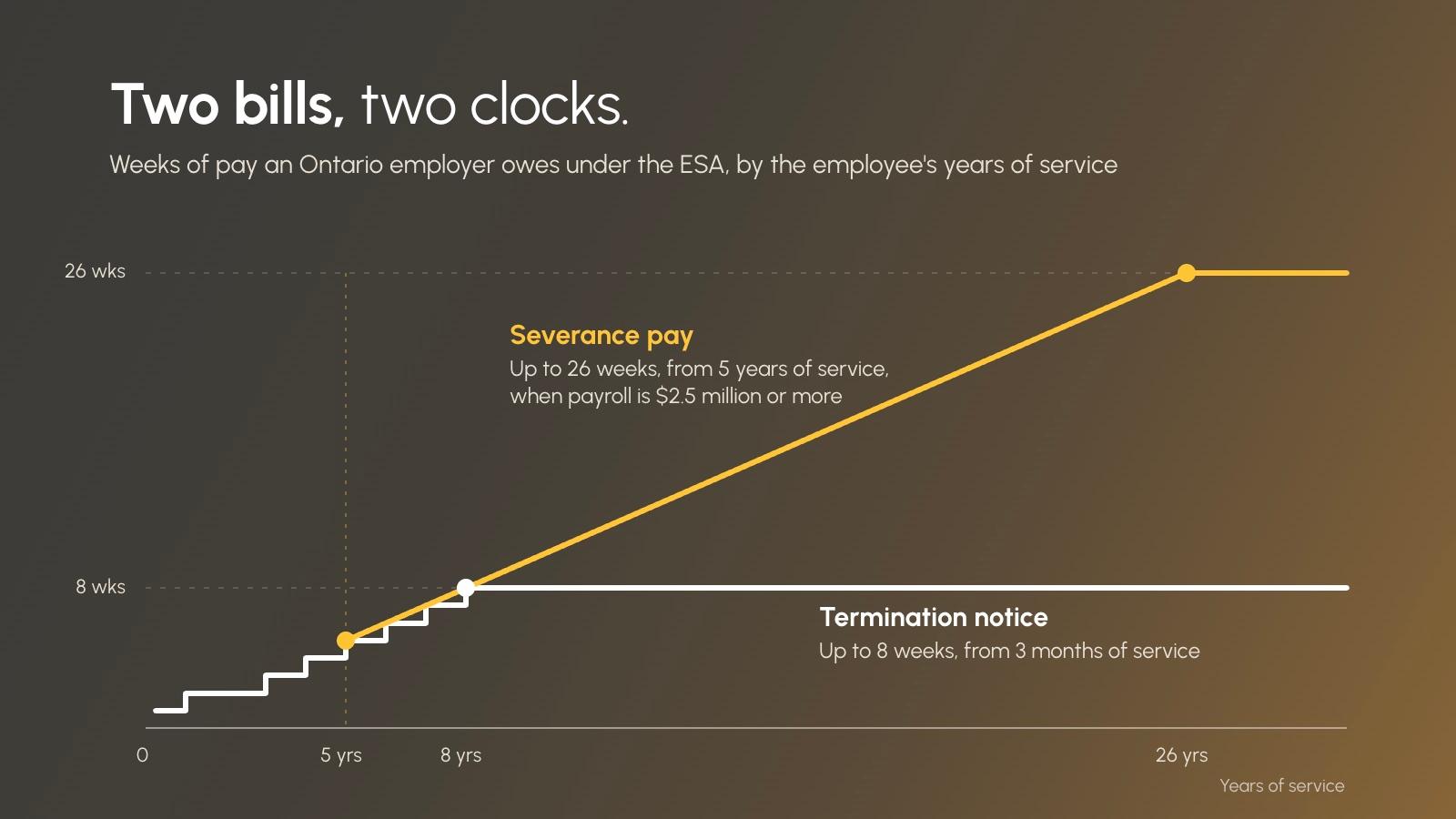
Termination notice and severance pay in Ontario by years of service
Ontario sets two separate minimums, and the table shows both by length of service. Termination notice under section 57 of the ESA climbs one week per year of service and stops at 8 weeks. Severance pay under sections 64 and 65 starts at 5 years and adds a week per year, up to 26 weeks.
Years of service | Notice or pay in lieu (s. 57) | Severance pay, if your payroll qualifies (s. 65) |
|---|---|---|
Under 3 months | None | None |
3 months to under 1 year | 1 week | None |
1 to under 3 years | 2 weeks | None |
3 to under 4 years | 3 weeks | None |
4 to under 5 years | 4 weeks | None |
5 to under 6 years | 5 weeks | 5 weeks plus 1/12 week per extra completed month |
6 to under 7 years | 6 weeks | 6 weeks plus months |
7 to under 8 years | 7 weeks | 7 weeks plus months |
8 to under 26 years | 8 weeks | 1 week per completed year, plus months |
26 years or more | 8 weeks | 26 weeks (the cap in s. 65(5)) |
Figures are Ontario's statutory minimums as of November 2026, from the Ministry of Labour's guide to termination of employment. A "week" means the employee's regular wages for a regular work week, without overtime. For someone on commission or variable hours, the ministry averages the regular wages from the weeks they worked in the 12 weeks preceding the notice.
Laying off 50 or more people at one establishment within four weeks switches you to the mass-termination rules in section 58, which run 8 to 16 weeks. This guide covers one employee at a time.
The $2.5 million payroll test decides whether severance pay applies
Severance pay in Ontario applies only when two tests are passed: the employee has 5 or more years with you, and your business has a payroll of at least $2.5 million (or is closing all or part of an establishment and letting 50 or more people go within six months). That's section 64(1).
The payroll figure is narrower than most owners assume. Section 64(2) takes the wages earned by all your employees in the last four completed weeks before the termination and multiplies them by 13. A 25-person business paying an average of $65,000 a year runs about $1.6 million on that test, which is under the line. A 45-person business at the same average is over it.
Two details in the ministry's policy manual catch employers out. The payroll counts globally, so staff you employ outside Ontario go into the total. Service, though, counts only in Ontario: five years at your Calgary office followed by two in Toronto is two years for severance purposes.
Worked example: 7 years, 4 months at $1,500 a week
An Ontario employee with 7 years and 4 months of service at $1,500 a week is owed $22,255 under the ESA minimums when the employer's payroll is $2.5 million or more. The four steps assume a salaried employee who works no overtime.
- Seven completed years puts the employee in the 7-week row. You pay the notice period as a lump sum: 7 × $1,500 = $10,500.
- With 5 or more years of service, Ontario's vacation pay rate is 6%, and the ministry applies it to termination pay: $10,500 × 6% = $630.
- The 7 weeks of notice you paid in lieu still count as service, the way the ministry's own example for an employee called Alex does it in the severance pay guide. That takes 7 years and 4 months to 7 years and 5 completed months. Section 65(1) multiplies the weekly wage by 7 + 5/12 years: $1,500 × 7 5/12 = $11,125.
- Severance pay carries no vacation pay under the ministry's policy, so step 3 stands unchanged.
The statutory total is $22,255. You also keep the employee's group benefits going for the full 7 weeks, which step 1 doesn't price.
Swap one fact and the bill moves. At a 30-person company under the payroll line, step 3 disappears and the ESA minimum drops to $11,130. At 4 years and 11 months, severance pay doesn't apply at any payroll size, and notice falls to 4 weeks.
What the termination payment must include, and by when
Termination pay and severance pay are both due on the later of seven days after the job ends or the employee's next regular payday, according to the termination and severance guides. Severance pay can go out in instalments over up to three years, but only with the employee's written agreement or the Director's approval, and one missed payment makes the whole balance due.
Benefits are the line employers forget. During the statutory notice period, section 60 requires you to keep making the contributions that maintain the employee's benefit plans, and section 62 treats the employee as actively employed for those plans even if you paid in lieu. If your insurer won't extend coverage, the cost of what the employee loses can land on you.
Notice has to be in writing to count under section 54. A conversation alone starts nothing.
Where the ESA minimum stops and common law starts
Common-law reasonable notice is the notice a court decides an Ontario employee should have received, and it applies on any termination without cause unless the employment contract limits the employee, enforceably, to the ESA amounts. Courts set it, and it turns on age, role, length of service and how easy similar work is to find. For a long-serving manager it often runs to months, well past the 8 weeks in section 57.
Your contract decides which number applies. In Waksdale v. Swegon North America Inc., 2020 ONCA 391, Ontario's Court of Appeal struck out an employer's entire termination clause because the just-cause part of it breached the ESA, even though the without-cause part was fine on its own and the employer never relied on the bad part. The employee got common-law notice instead. Contracts drafted ahead of that ruling are worth a second look for this reason, and our guide to the types of employment contracts in Canada covers what a sound one contains.
The employee picks one route. The severance guide says they can either file an ESA claim for termination and severance pay or sue for wrongful dismissal over the same termination, but not both.
How Ontario compares to BC and Alberta
Ontario is the only one of the three provinces that adds statutory severance pay on top of termination notice. All three cap statutory notice at 8 weeks.
Ontario | British Columbia | Alberta | |
|---|---|---|---|
Notice starts after | 3 months | 3 consecutive months | 90 days |
Statutory notice cap | 8 weeks (8+ years) | 8 weeks (8+ years) | 8 weeks (10+ years) |
Statutory severance pay | Yes, up to 26 weeks | None | None |
Source |
Rules as of November 2026, from each province's employment standards office.
Common questions
How long does an Ontario employer have to issue a Record of Employment?
An employer filing electronically has 5 calendar days after the end of the pay period in which the employee's earnings stopped, according to Service Canada's ROE guide. If you pay monthly or 13 times a year, the deadline is the earlier of that date or 15 calendar days after the earnings stopped. A paper ROE is due within 5 calendar days of the interruption.
Can I terminate an employee who is on a WSIB claim in Ontario?
Terminating an employee on a WSIB claim is high risk and sometimes unlawful. If you regularly employ 20 or more workers and the employee had worked for you continuously for at least a year when injured, you have a re-employment obligation, and the WSIB presumes a breach when a re-employed worker is let go within six months, under its re-employment policy 19-02-09. The penalty can reach the worker's net average earnings for the year preceding the injury, and the Human Rights Code duty to accommodate applies on top.
What should I say when terminating an employee in Ontario?
Keep the meeting short and hand over the written notice that section 54 requires. Say the employment is ending and give the last day. Then walk through the letter: termination pay, severance pay if it applies, how long benefits continue, vacation pay owing and when the ROE will be filed. Skip debating the reasons, which tends to become evidence later.
Is there a probation period in Ontario?
Ontario's ESA uses a three-month threshold: an employee with less than three months of service isn't owed notice or termination pay under the termination guide. Common-law notice can still apply in those first months unless the contract has an enforceable probation clause.
What is the difference between just cause and without cause in Ontario?
Without cause means you're ending the job for business reasons and owe notice and, where it applies, severance pay. Just cause at common law means serious misconduct that removes the common-law notice. The ESA uses a stricter test, "wilful misconduct, disobedience or wilful neglect of duty that is not trivial and has not been condoned by the employer", so an employee you dismissed for cause can still be owed their ESA termination and severance pay.
What is wrongful dismissal in Ontario?
Wrongful dismissal is a lawsuit claiming the employer ended the job without the notice the employee was owed, usually common-law reasonable notice beyond the ESA minimum. It's most likely when the contract has no termination clause or one that a court finds unenforceable. An employee who sues can't also file an ESA claim for the same termination.
If you're about to give notice, put it in writing today and start the ROE clock from the last pay period. A senior HR advisor on the Expert Network can check your letter and its numbers the same day, which is a core part of what an HR consultant does for a small employer. That's HR help for your business; when the contract wording itself is the problem, it moves to legal help for your business. See Vistera pricing for what a review costs.
This guide is general information about Ontario's employment standards as of November 2026, not legal advice for your situation.