What Does a Business Lawyer Do? A Guide for Canadian Small Business Owners
Vistera6 min read
Updated August 10, 2026
What does a business lawyer do? In short, they keep a company out of expensive trouble. A business lawyer drafts and reviews the contracts you sign, papers your corporate structure, sorts out employment matters like hiring and terminations, protects your intellectual property, and steps in when a dispute shows up at the worst possible moment.
Unlike a litigator who spends their career in courtrooms, a business attorney spends theirs preventing you from ever needing one.
It isn’t rare for Canadian small business owners to meet their first business lawyer under fire. When an employee resigns and threatens a claim, or an acquirer sends a term sheet with a clause that seems fine and isn’t, that’s when most business lawyers get a call.
The problem is by then, the cheap version of the problem has already passed. The prevention aspect was thrown out the window for the sake of saving money on a lawyer’s bill.
What is a business lawyer?
A business lawyer is a licensed lawyer who advises companies on the legal side of operating and growing. In Canada, that means someone who has been called to the bar in the province where your business operates, regulated by that province's law society, and carrying professional liability insurance for the advice they give.
The title covers a wide range. Some business lawyers focus narrowly on employment or intellectual property. Others work across the whole picture for smaller companies that need one person who can do it all.
What they share is a licence, and the professional accountability that comes with it.
What does a business lawyer do day to day?
The work sorts into five recognisable areas.
Contracts: The bulk of their work. Customer agreements, vendor terms, master service agreements, NDAs, commercial leases, and every other document your business signs. A business lawyer reads for the things that cost money later: unlimited liability, automatic renewals, one-sided indemnities, and termination clauses drafted for the other party's benefit.
Employment: Offer letters and employment agreements with enforceable termination provisions. Severance calculations that account for both statutory minimums and common law entitlement. Contractor classification, which the Canada Revenue Agency examines more closely year over year. Restrictive covenants that survive scrutiny in your province, including Ontario's non-compete ban.
Corporate structure: Incorporation, shareholder agreements, share issuances, and the reorganisations that arrive when a business grows or changes hands. A shareholder agreement is the document nobody wants to spend money on and everybody wishes they had the day two founders stop agreeing.
Intellectual property: Trademark clearance and filing with the Canadian Intellectual Property Office. IP assignment agreements so your company owns the code, content, and product it paid employees and contractors to create. Increasingly, AI use policies covering what your team can feed into which tools.
AI, privacy and data: Compliance programs under PIPEDA and provincial privacy legislation, website terms, and the data processing agreements that enterprise customers now require ahead of signing anything.
That's the answer to what does a business lawyer do. It isn’t like the movies. Less courtroom drama, more paperwork that quietly prevents disasters.
When do I need to hire a business lawyer for my small business?
It depends drastically on the circumstances, but the trigger is usually one of five moments.
You're signing something with meaningful money or liability attached.
You're hiring, firing, or restructuring a team.
You're incorporating, adding a shareholder, or changing ownership.
You're protecting a brand, a product, or a codebase.
Or you've received something that kept you up at night: a demand letter, a tribunal complaint, a regulator's inquiry.
Owners tend to wait until the fifth one, without realizing that’s the most expensive place to start.
What will save your company money is engaging a business lawyer within the first four moments, when the work is drafting rather than defending. A properly written employment agreement costs a fraction of a wrongful dismissal claim, and same goes for shareholder agreements, AI use policies, and more.
What a business lawyer won't do
It’s worth it knowing the boundaries.
Business attorneys aren’t your accountant. They advise on the structure and the tax consequences of a transaction, but they don't file your return.
They aren't your HR department either, though there's overlap. An HR advisor manages the people process; a business lawyer assesses the legal exposure sitting underneath it.
And most business lawyers don't litigate. If a matter reaches court, it usually moves to a litigator, which is a different practice altogether.
How to find a lawyer for your small business
Three things matter more than the rest.
Jurisdiction: Employment standards, privacy legislation, and corporate law all vary by province. A lawyer licensed in British Columbia can't advise on Ontario's employment rules with the same authority. Verify licensing through the relevant law society, or start with theCanadian Bar Association for general guidance on finding counsel.
Relevant experience: Someone who has drafted forty shareholder agreements for companies your size will catch things a generalist won't. Ask what they've done recently that resembles your matter.
Pricing you can see in advance: Hourly billing means the cost is unknown until the work finishes, which is why so many businesses avoid calling in the first place. Flat and transparent pricing removes that problem entirely.
That last point deserves more attention than it usually gets. The reason small businesses under-use legal help isn't that they don't value it. Quite on the contrary. It's that an open-ended hourly meter makes every question feel expensive, so questions go unasked and problems compound quietly.
Be careful of hourly billing
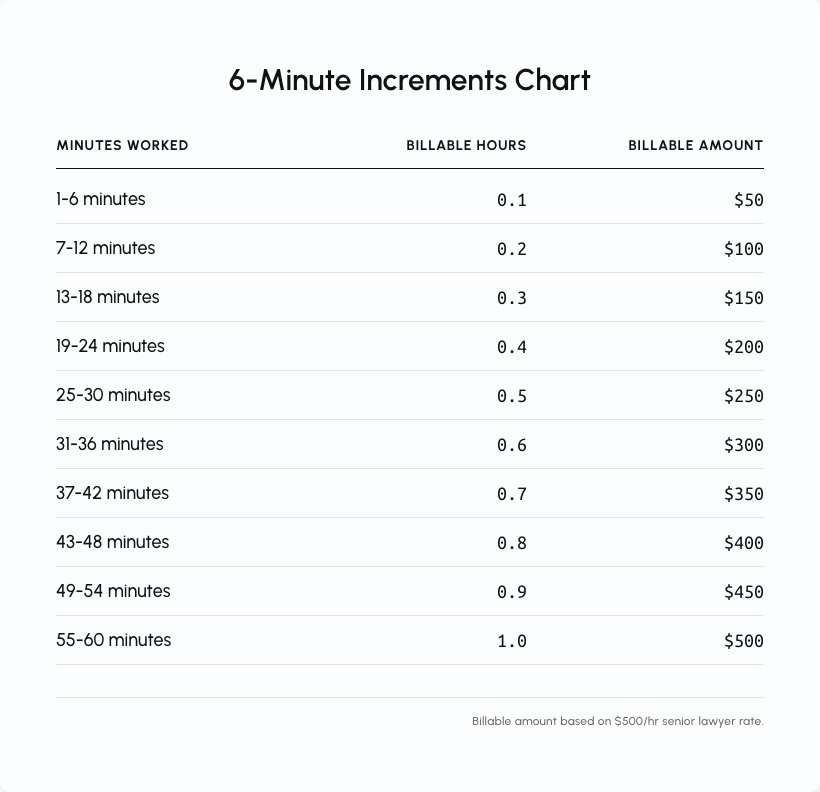
The six-minute increment is the status quo of the legal world. Every one to six minutes a lawyer spends on your file bills as 0.1 of an hour.
So an email answering a couple of questions about a demand letter you received costs you 0.2 billable hours. At $500 an hour for a senior business lawyer, that email is $100.
You read that right.
And whether the lawyer spent seven minutes on it or twelve, the number on your invoice is identical. The increment rounds up, always in one direction.
This is the standard that traditional legal firms have had in place for decades. It’s disclosed in every retainer agreement, and it works exactly as designed. The problem is what it does to your need for legal help.
Once you understand that a two-line question costs a hundred dollars, you stop asking two-line questions, and the small clarifications that would have prevented a larger problem never happen.
What business legal services cost in Canada
Business lawyers in Canada generally charge somewhere between $300 and $600 an hour, with senior lawyers at BigLaw reaching $800 an hour.
Hourly rates only tell you part of the story though, because what you care about is the total. In a 2021 annual survey, Canadian Lawyer found that a simple small business incorporation averaged $1,094 nationally, rising to $1,292 in British Columbia.
Moreover, a basic employment contract review averaged $994, severance package reviews came in at $1,284, and standard workplace policies at $2,857.
Those are 2021 figures, and fees have climbed since.
Note what they have in common: none of them are specialized, out-of-scope outcomes for a small business. Incorporating, papering an employment agreement, reviewing a lease. This is the ordinary machinery of running a company, and a small business doing three or four of those in a year is looking at five figures.
Flat-rate models, like Vistera, price the outcome instead. You know the number going in, and it doesn't move based on how long the lawyer spends.
For a business signing contracts weekly and getting one looked at annually, the difference isn't academic. It decides how often you get proper advice.
The short version
What does a business lawyer do? They read the documents you're about to sign, write the ones you need, structure the company properly, protect what you own, and answer the questions that keep you up on a Sunday night.
The work is unglamorous and it's the reason well-run companies stay out of court.
If you're weighing whether to contract one, ask yourself: is there a decision sitting on your desk right now where being wrong would cost more than the advice? If yes, that's your answer.
Vistera connects Canadian small businesses with senior lawyers throughbusiness legal services priced per outcome, with every file signed off by a licensed expert on theVistera Expert Network.