An operations lead at a 40-person distributor in Calgary types a question into ChatGPT on a Thursday afternoon: how much notice do I owe a warehouse supervisor with seven years' service if we let him go without cause? ChatGPT will answer. Whether the answer is right turns on one fact the question never stated, which is the province.
Vistera vs ChatGPT comes down to who acts on the answer. Keep ChatGPT for first-pass reading, such as learning a term or drafting questions for an expert. It's free, and for that job it's the right call on its own. Use Vistera when someone is about to act on the answer and the answer depends on your province, in BC, Alberta or Ontario, because a senior expert licensed in that province signs off on the outcome.
One question, three provincial answers
A warehouse supervisor with seven years' service, let go without cause, is owed a different statutory minimum in each of Alberta, BC and Ontario, as of November 2026. In Alberta, seven years of service falls in the "6 years but less than 8 years" row of the Employment Standards Code's termination table, so the employer owes 5 weeks of notice or the matching termination pay.
Move the same supervisor to Vancouver and the number is 7 weeks, because section 63 of BC's Employment Standards Act starts at 3 weeks after 3 years and adds a week for each further year, to a cap of 8.
Ontario also says 7 weeks of notice under the ESA termination rules, then stacks a second bill on top: with five or more years of service and a global payroll of at least $2.5 million, the employer owes ESA severance pay as well, which for exactly seven years comes to 7 more weeks of regular wages. Alberta and BC have no statutory severance pay at all. Same employee, same question: 5 weeks, 7 weeks, or as many as 14. Those are only the statutory floors, and a contract without an enforceable termination clause can leave the employer owing common-law notice well past any of them.
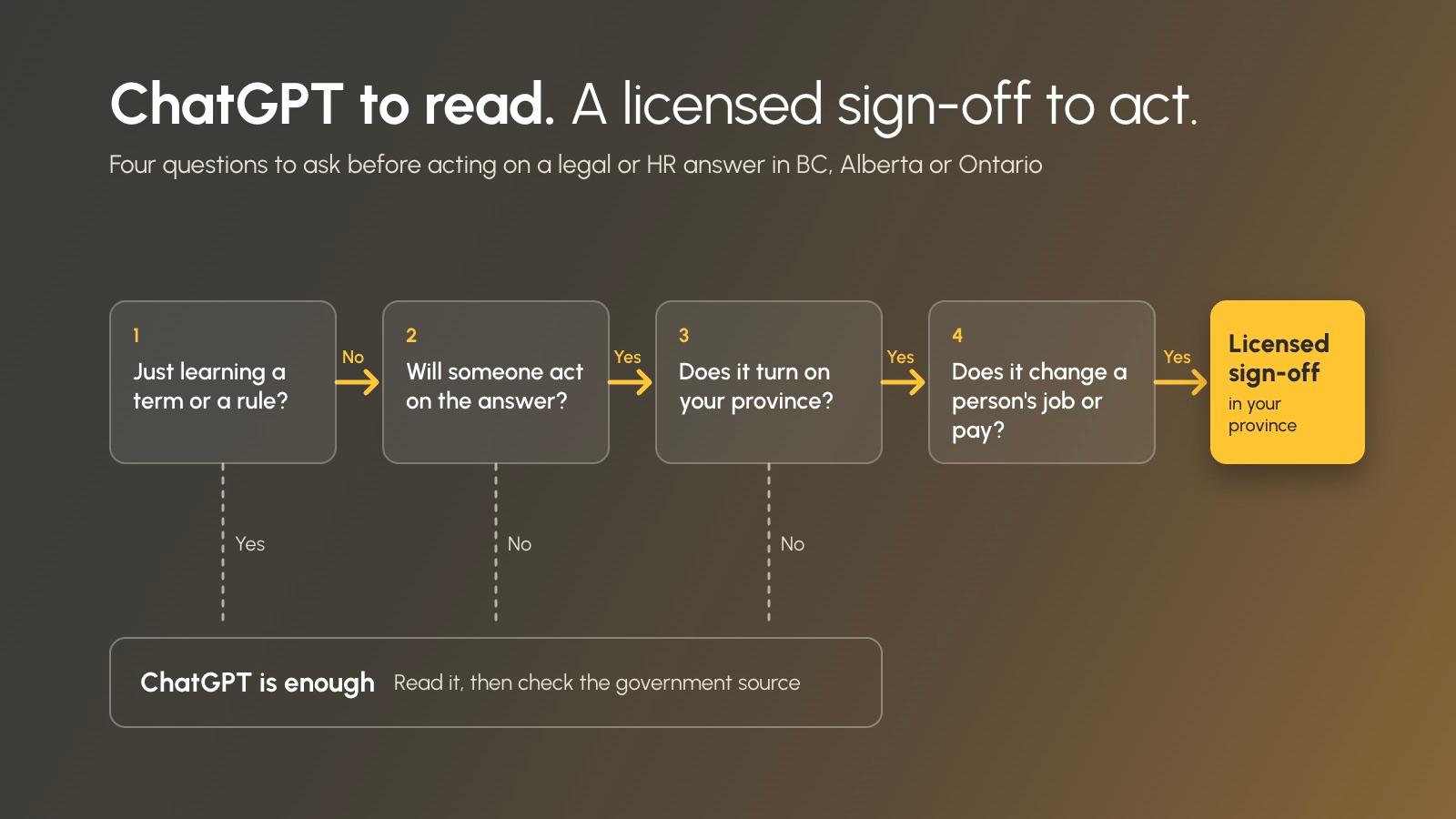
The decision tree: when ChatGPT is enough and when you need a licensed sign-off
The deciding question is whether a specific employee's job or pay will change because of the answer. Work down the four questions below. Stop at the first sign-off.
- Are you trying to understand a term or the general shape of a rule?
- Yes: ChatGPT is enough. Ask it what "constructive dismissal" means, or how termination pay differs from severance pay. Then open the government page it should point you to and read the rule there.
- No: go to question 2.
- Will someone act on the answer? Sending a letter, paying an amount, signing a contract and changing a policy all count.
- No: ChatGPT is still enough. Use it to draft the questions you'd bring to an expert, or to summarise a long document so you know where to look.
- Yes: go to question 3.
- Does the answer turn on your province, or on one person's facts? Length of service, pay, the wording of their contract and a leave they're on are all facts of that kind.
- No: the answer is general, such as a standard meeting agenda or a checklist of documents to gather. Check it against the source and use it.
- Yes: go to question 4.
- Will the decision affect a specific person's job or pay?
- Yes: get a licensed sign-off before you act. OpenAI's own terms tell ChatGPT users not to use its output for this kind of decision, which the next section quotes.
- No: a sign-off is still worth it when being wrong costs more than the outcome does. A supplier contract with an automatic renewal is a common example.
A typical HR question starts at question 1, where ChatGPT does fine, and ends at question 4 the moment an employee's name is attached. So use them in that order.
Can ChatGPT give legal advice? What OpenAI's own terms say
OpenAI's rules for ChatGPT tell users not to rely on its output for employment or legal decisions about a person. The Terms of Use that apply in Canada, effective January 1, 2026, say:
"You must not use any Output relating to a person for any purpose that could have a legal or material impact on that person, such as making credit, educational, employment, housing, insurance, legal, medical, or other important decisions about them."
A termination is an employment decision. The same terms say you should not rely on output "as a substitute for professional advice."
OpenAI's usage policies add two lines on top. The version effective October 29, 2025 bars the "provision of tailored advice that requires a license, such as legal or medical advice, without appropriate involvement by a licensed professional." It also bars "automation of high-stakes decisions in sensitive areas without human review", and employment and legal are both on the list. A revised version takes effect November 20, 2026. It keeps the human-review rule and aims the licensed-advice rule at companies that offer AI tools giving tailored advice. It also adds that you "may not state or imply that the AI itself holds professional credentials or authorization."
Taken as a set, OpenAI's terms put a licensed professional at the point where a decision about a specific person gets made, which is question 4 of the tree above.
Vistera vs ChatGPT at a glance
ChatGPT is a general-purpose AI assistant that answers questions on any topic, on a free or paid monthly plan. Vistera is a professional services technology platform where AI prepares the file and a licensed senior expert in your province signs off. The table compares AI legal and HR help from ChatGPT with Vistera's expert sign-off, as of November 5, 2026, using OpenAI's own published pages for the ChatGPT column.
ChatGPT | Vistera | |
|---|---|---|
Price model | Free plan at CA$0 a month; paid individual plans from CA$11 a month (chatgpt.com/pricing) | Pay As You Go at $700 per outcome, or a plan from $500 per outcome (Standard) or $450 (Premium) on annual billing; monthly billing has no minimum term |
Who does the work and signs off | The model writes the answer; nobody signs it | Vero, Vistera's AI, does the intake and document prep; a senior expert on the Expert Network does the judgment and signs off |
Provinces | Any jurisdiction you name; not licensed in any province | BC, Alberta and Ontario, with the expert licensed in the province where the matter sits |
Disciplines | Any topic | Legal, HR and finance |
Turnaround | Replies inside the chat | An expert picks up the file the same day |
Accountability | Output is used "at your sole risk"; OpenAI caps its liability at the greater of what you paid in the past 12 months or $100, where the law allows (Terms of Use) | The expert's name and credentials are on every file; legal work is done by Spraggs Law and other independent lawyers, each regulated by their provincial law society |
Best for | Learning terms, general reading, drafting questions, summarising documents | Decisions about a specific person or contract that depend on the province |
The cost difference has a plain basis: ChatGPT's Free plan is CA$0, and every Vistera outcome is paid. What the money buys is the sign-off and someone accountable for it.
Where ChatGPT is the better choice
ChatGPT wins on general reading. It's free. It's open at midnight. Ask it what "pay in lieu of notice" means and you get a plain answer without opening a file. It also does a good job of turning a 40-page lease into a list of clauses to ask about. For any of those, skip the outcome. Use ChatGPT.
On ChatGPT's Free, Go, Plus and Pro plans, OpenAI's pricing page says content is used to train its models, with an opt-out available. Think twice before pasting an employee's name and medical leave into a chat.
Using both on one file
ChatGPT goes first and Vistera second on the same file. Read up in ChatGPT at whatever hour suits you and for as long as you like, then bring the decision itself to Vistera, where Vero, the platform's AI, works out the discipline and the province and prepares the documents. A senior expert licensed in your province picks up the file the same day and signs off. For the Calgary warehouse supervisor in the opening example, that means an expert licensed in Alberta checks the weeks owed and the contract's termination clause ahead of the meeting.
Vistera uses AI as well, and a licensed person puts their name on the file at the end. If you're still deciding which kind of expert you need, our guides to what an HR consultant does and what a business lawyer does set out where each one's work starts, and the guide to the types of employment contracts in Canada covers the termination clause that decides whether common-law notice applies.
Common questions
Can ChatGPT draft a termination letter?
ChatGPT can produce a draft termination letter, and it will read well. The notice weeks and any severance pay in it depend on the province, and OpenAI's Terms of Use say not to use its output for employment decisions about a person.
Have the letter checked by an expert licensed in your province before you hand it over.
Is Vistera a law firm?
Vistera is a professional services technology platform. Legal work on Vistera is done by the Expert Network and by Spraggs Law, the affiliated law firm, and each lawyer is regulated by the law society of the province where they practise.
Does Vistera use AI?
Vero, Vistera's AI, takes in the request and prepares the documents. A senior expert licensed in your province checks the work and signs off on it.
Next step
When a letter is about to go out, put the question in front of someone licensed in your province. Start for free and describe it to Vero, or book a demo to see how a file moves. For HR questions, see HR help for your business. For contracts and disputes, see legal help for your business. Plans and per-outcome costs are on the pricing page: see Vistera pricing.
Sources, checked on 2026-11-05
- OpenAI, Terms of Use (effective January 1, 2026)
- OpenAI, Usage policies (version effective November 20, 2026) and the October 29, 2025 version
- OpenAI, ChatGPT plans and pricing
- Government of Alberta, Termination pay
- Government of BC, ESA section 63 interpretation guidelines
- Government of Ontario, Termination of employment and Severance pay
ChatGPT and OpenAI are trademarks of OpenAI. Trademarks belong to their owners. OpenAI isn't affiliated with Vistera and hasn't reviewed this post.
Vistera Technologies Corp. is a technology company, not a law firm, and does not provide legal advice. Legal services are provided by Spraggs Law and other independent lawyers and law firms, each regulated by the law society of the province in which they practise. Use of the Vistera platform alone does not create a solicitor-client relationship; that relationship arises only under a retainer between the client and the assigned lawyer or firm.